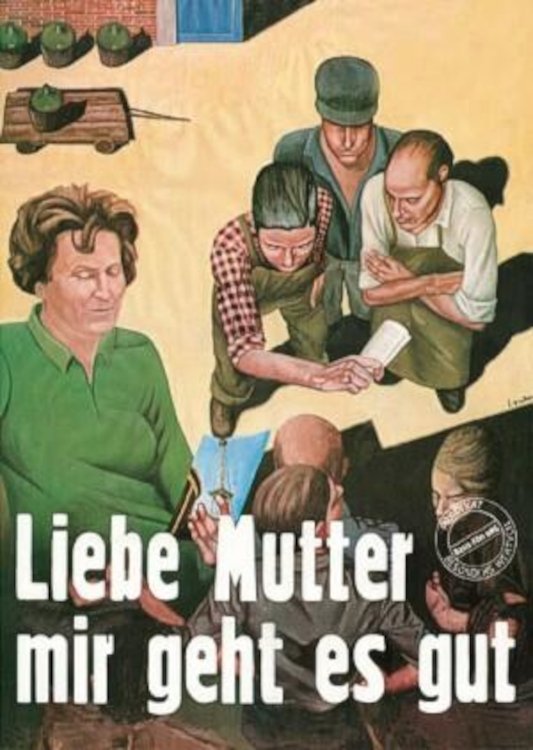
Liebe Mutter, mir geht es gut (1972)
The unemployed machinist Alfred "Scheff" Schefczyk moves from Württemberg to West Berlin full of hope, where he finds a job as a transporter. There, however, he despairs at the seemingly insurmountable dependency structures and the lack of solidarity among his fellow sufferers. The rent in the workers' hostel is raised disproportionately, but nobody wants to mess things up with the landlord or janitor. At work, piecework hours are tightened, but nobody wants to go on strike, and when they do, they are quickly crushed by the management's tactics. When Scheff tries to mobilize against the dismissal of one of the delegates, he finds only one worker willing to sign. "Dear mother, I'm fine," he nevertheless writes on a postcard.
Director: Christian Ziewer
 |
Claus Eberth as Alfred Schefczyk |
|
Nikolaus Dutsch as Bruno Behringer |
|
Ernest Lenart as |
 |
Horst Pinnow as |
 |
Christian Brückner as Rudi |
|
Manfred Meurer as Bieler, Betriebsleiter |
|
Klaus Sonnenschein as Walter |
|
Heinz Hermann as |
|
Kurt Michler as |
|
Axel Böhmert as |
|
Alexander Bzik as |
|
Erhard Dhein as |
|
Heinz Giese as |
 |
Henning Gissel as |
 |
Claus Jurichs as |
|
Günther Kieslich as |
 |
Erik von Loewis as |
|
Marianne Lüdcke as |
 |
Horst Tomayer as |
| Production | Renée Gundelach | Executive Producer |
| Directing | Christian Ziewer | Director |
| Writing | Christian Ziewer | Writer |
| Writing | Klaus Wiese | Writer |
| Editing | Stefanie Wilke | Editor |
| Camera | Jörg-Michael Baldenius | Director of Photography |