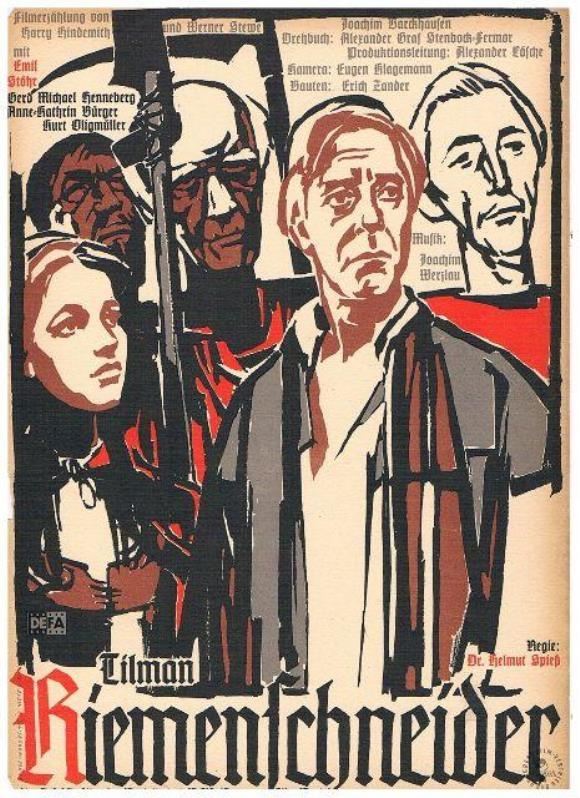
Tilman Riemenschneider (1958)
The important German wood sculptor Tilman Riemenschneider (born around 1460) is considered to be artistically and socially established. He was a councillor in Würzburg and held several offices. In his works and in the way he conducted his office, he showed himself to be connected to the common people, who revered him. But he also had a patron in the art-loving Prince-Bishop Konrad von Thüngen. But when the peasants' uprising spread to Würzburg in 1525, Riemenschneider stood up for the rights of the peasants and opposed the use of soldiers, Thüngen became his bitter opponent. Although he initially flees from the superior forces, he returns after the uprising has been suppressed and imprisons Riemenschneider. Weeks later, he is released from prison. His hands were broken, but not his steadfastness.
Director: Helmut Spieß
 |
Annekathrin Bürger as Anna |
 |
Kurt Oligmüller as Domherr |
 |
Gerd Michael Henneberg as Fürstbischoff Konrad von Thüringen |
 |
Emil Stöhr as Tilman Riemenschneider |
 |
Hartmut Reck as Gotthold |
 |
Gisela May as |
|
Johannes Curth as |
 |
Hanns Anselm Perten as |
 |
Peter Herden as |
|
Gert Beinemann as |
|
Werner Hammer as |
|
Hans Stetter as |
|
Ilse Bastubbe as |
 |
Fred Düren as |
| Directing | Helmut Spieß | Director |
| Writing | Joachim Barckhausen | Writer |
| Writing | Alexander Stenbock-Fermor | Writer |
| Editing | Ursula Rudzki | Editor |
| Sound | Joachim Werzlau | Original Music Composer |
| Camera | Eugen Klagemann | Director of Photography |